Lift Every Voice And Sing- Augusta Savage at the World’s Fair 1939
The technological advancements of the 19th century gave way to a (not so) first wave of globalization. One could argue the Silk Road was the first major wave of globalization. However, the new and improved interconnectedness of the 19th century allowed various countries to get together and showcase what technological, artistic, and cultural advancements they had at a convention called “The World’s Fair”, also called the Universal Exhibition, or the World Expo.
From the mid 1800’s, the main focus of the fair was scientific and technological advancements, with very little art. After the turn of the century, emphasis on artistic and cultural advancements became more and more popular.
The 1939 World’s Fair was set in New York. In the midst of pre war, post Women’s Suffrage movement, Great Depression, and difficult race relations, America was to show the world the ‘world of tomorrow’.

Postcard from the World’s Fair, 1939
Out of all of the amazing technological, architectural, cultural, and whatever else the World’s Fair had on view, one sculpture stood out-
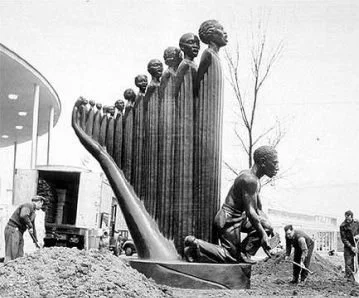
“Lift Every Voice and Sing” by Augusta Savage.

Postcard/photo of Augusta Savage’s "Lift Every Voice and Sing”, 1939.
Originally from Florida, Augusta Savage was a sculptor, teacher, and an activist, contributing greatly to the Harlem Renaissance. Despite having all odds against her, Augusta’s impact on art in America during her life was extremely influential; So much so, she was chosen to create a sculpture for the World’s Fair.
The sculpture was conceptualize African American music in America. Between the boom of the 1920’s and the music coming out of the 1930’s, black musicians were on the forefront of popular culture.
The sculpture stood 16 feet in height and was placed right outside the fair’s entrance. It was one of only two works by African American artists featured at the World’s Fair. The title is from a song by James Weldon, in which the song has themes of perseverance and faith, hence the choir inspired formation and clothing of the figures.
“We have come, treading our path through the blood of the slaughtered
Out from the gloomy past
'Til now we stand at last
Where the white gleam of our bright star is cast”
It was the most popular work of the entire fair, yet, it was destroyed after the fair was concluded. Small scale collectibles of the sculpture and postcards were sold instead of keeping this amazing piece of art history intact. Though the sculpture was destroyed, Augusta’s sculpture will live forever; I guess one could say the destruction of the sculpture furthers the concept of perseverance Weldon’s song spoke about.
VN
